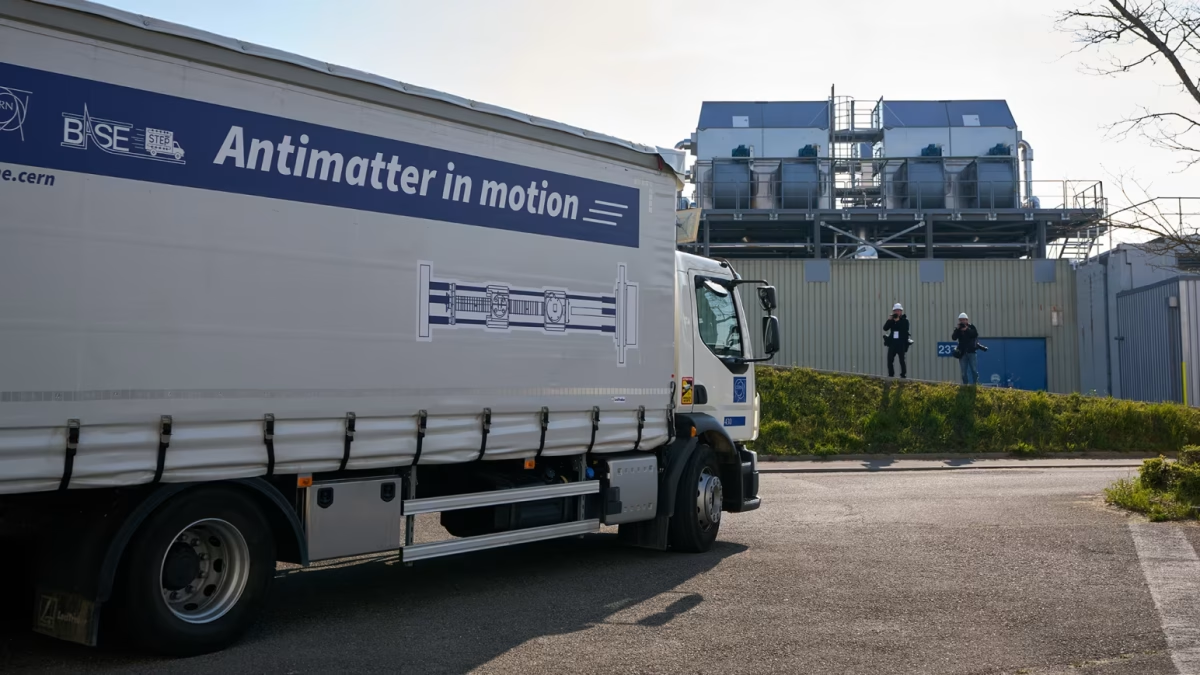
On March 24, humans’ first successful transport of antimatter in a vehicle was achieved by a team of scientists from CERN, the European Organization for Nuclear Research. 92 antiprotons were stored on a truck that traveled 8 kilometers for about 30 minutes around the laboratory. The goal of this journey was to ensure the viability of antimatter transportation and to prepare for the next step: transporting antimatter to precision laboratories at the Heinrich Heine University in Düsseldorf, 700 kilometers from CERN.
Antimatter is almost identical to ordinary matter, but with totally reversed charge and magnetic moment. It will trigger a phenomenon known as annihilation when it meets ordinary matter, completely transforming into energy. This is probably its most well-known property. Theoretically, the Big Bang should have produced equal amounts of matter and antimatter at the beginning of time, causing a total annihilation of matter that leads to an empty universe. That obviously had not happened, and the majority of matter is ordinary matter. This imbalance has remained unexplained for decades.
To solve the mystery of antimatter, the Baryon Antibaryon Symmetry Experiment at CERN, known as BASE, has been dedicated to precisely measuring antiproton properties and to studying the subtle differences between antiprotons and ordinary protons. The antimatter factory at CERN has been the only place in the world capable of producing and storing antiprotons for over a year. The storage of antiprotons for such a long period is achieved using 2 successive decelerators that reduce their energy, thereby facilitating storage and study. One challenge they faced, however, was fluctuations in the magnetic field produced by their factory equipment, which affected the measurements. The fluctuations are pretty weak yet overly impactful for the necessary high precision of measurements and might severely disrupt the data. Therefore, they planned to transport antiprotons from CERN to a lab to minimize disruption and achieve higher precision.
The BASE collaboration developed an apparatus that enables continuous trapping of antiprotons during transport, named the BASE-STEP trap. It essentially contains a vacuum chamber and a Penning trap, which are specifically designed to store charged particles using special electric and magnetic fields. These fields are generated by a superconducting magnet, trapping the antiprotons in the center of the chamber, preventing them from touching the chamber’s wall. Additionally, the inner environment must be maintained at an extremely low temperature at which the superconducting magnet can operate, and the thermal activity of antiprotons would be constrained to some extent by a liquid helium cryogenic cooling system. The apparatus weighs 1000 kilograms and fits through laboratory doors. It’s specially designed to withstand the jolts and vibrations during transportation, while scientists constantly monitor the antiprotons’ condition. All the methods mentioned above enabled the safe transport of 92 antiprotons.
In fact, BASE already verified the feasibility of the project with regular protons last year, and this successful attempt to transport antiprotons is a preview of delivering antiprotons to HHU, which would be an 8-hour journey. The team identified that more improvements are still necessary for this project. For example, they would probably have to add a generator to power a cryocooler in the truck to maintain the required low temperature. Still, this success has been undeniably a significant breakthrough.
Due to its 100% energy-conversion efficiency, annihilation has been depicted as an extremely powerful and dreadful disaster. In a novel named Death’s End, a character named Thomas Wade builds an army that weaponizes antimatter by using electromagnetic fields to trap enough antimatter in their bullets that could easily destroy spaceships. However, despite how hazardous it may sound to have antimatter loaded onto a truck and transported, we should also keep in mind that only 92 antiprotons were involved in the transport. If they annihilate with equal amounts of matter, the amount of energy released would be 2.76982×10⁻⁸ joules, which is too small to be even sensed by humans.
The imaginary scenario of antimatter weapons seemed too far from our current technology, and we haven’t yet known lots about antimatter. However, this breakthrough advances our vision toward a broader future of technological advancement, in both directions: discovering the secret of the universe and developing what is likely the most efficient source of energy.
Works Cited
BASE. (n.d.). CERN. https://home.cern/science/experiments/base
BASE experiment at CERN succeeds in transporting antimatter [BASE experiment at CERN succeeds in transporting antimatter]. (2026, March 24). CERN. Retrieved April 28, 2026, from https://home.cern/news/press-release/experiments/base-experiment-cern-succeeds-transporting-antimatter
Gibney, E. (n.d.). Antimatter has been transported for the first time ever — in the back of CERN’s truck [Antimatter has been transported for the first time ever — in the back of CERN’s truck]. Nature. https://doi.org/10.1038/d41586-026-00950-w