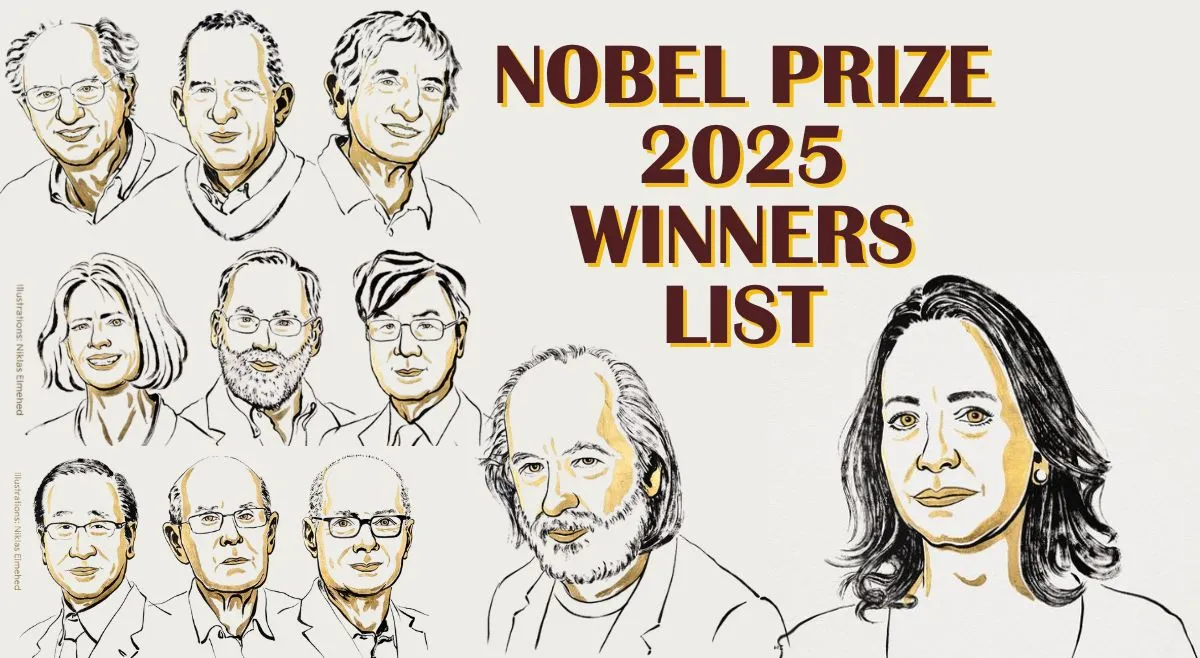
This year’s Nobel Prizes were announced in mid-October, recognizing influential figures spanning six fields: physics, economics, peace, literature, chemistry, and physiology. The prizes honor fourteen scientists, writers, economists, or activists for their extraordinary endeavors in addressing global challenges, bringing world peace, technological and scientific advancement, and bright innovations. Celebrating their accomplishments reminds us that innovation and compassion propel us to a more just and sustainable future.
Awarded by the Norwegian Nobel Committee, the 2025 Nobel Peace Prize is given to Mariá Corina Machado, a Venezuelan politician and activist who is known for leading the opposition against the regime in Venezuela to ensure free and fair elections for her country. Machado is acclaimed “for her tireless work promoting democratic rights for the people of Venezuela and for her struggle to achieve a just and peaceful transition from dictatorship to democracy.” She faced challenges, such as being unjustly prevented from running the presidential election, when she was already “appointed the candidate of the opposition.” As Jorgen Watne Frydnes, chairman of the Norwegian Nobel Committee, says on the day of the announcement, Mariá Corina Machado “keeps the flame of democracy burning amidst a growing darkness.”
This year’s Physics Prize goes to John Clarke (UK), Michel H. Devoret (France), and John M. Martinis (USA), presented by The Swedish Royal Academy of Sciences. In the experiments they conducted in 1984-1985, they discovered that quantum physics and funnelling — only seen in atoms — could occur in electrical circuits large enough to be visible to human eyes. They built special circuits where a Josephson junction (like artificial atoms) occurs, and quantum mechanical effects appear.
Also awarded by The Swedish Royal Academy of Sciences, the Chemistry Prize is awarded to Susumu Kitagawa (Japan), Richard Robson (Australia), and Omar Yaghi (USA) for building “molecular constructions with large spaces through which gases and other chemicals can flow.” MOFs (Metal-organic framework) act like “molecular sponges” that can purify and store water, deliver drugs within the human body, and clean up the environment.
László Krasznahorkai (Hungary) won the Literature Prize, “for his compelling and visionary oeuvre that, in the midst of apocalyptic terror, reaffirms the power of art.” Novels Krasznahorkai wrote, such as Satantango and The Melancholy of Resistance, use powerful language and long and flowing sentences to create meaning in the midst of collapse and uncertainty.
Mary E. Brunkow (USA), Frederick J. Ramsdell (USA), and Shimon Sakaguchi (Japan) are awarded the Nobel Prize in Physiology and Medicine “for their discoveries concerning peripheral immune tolerance.” They discovered that regulatory T-cells prevent immune cells from attacking the human body, which results in autoimmune diseases.
Last but not least, The Sveriges Riksbank Prize in Economic Sciences in Memory of Alfred Nobel 2025 was granted: one-half to Joel Mokyr (the Netherlands) “for having identified the prerequisites for sustained growth through technological progress,” and the other half shared by Philippe Aghion (France) and Peter Howitt (Canada) “for the theory of sustained growth through creative destruction.” Their work has shown how innovation and creativity propel long-term economic growth.
Across science, literature, and human rights, the fourteen Nobel laureates in 2025 show that with imagination, determination, and innovation, the world will be a more peaceful, enlightened, and equitable place. The breakthroughs in technology and science, and creativity in literature and economics, drive us to explore and discover more meanings in this world.
Works Cited
Jeyaretnam, Miranda. “Venezuelan Democracy Advocate María Corina Machado Receives 2025 Nobel Peace Prize.” TIME, Time, 10 Oct. 2025, time.com/7324886/maria-corina-machado-nobel-peace-prize-2025-venezuela-opposition-democracy/.
Megha Satyanarayana. “2025 Chemistry Nobel Goes to Molecular Sponges That Purify Water, Store Energy and Clean up the Environment.” Scientific American, 8 Oct. 2025, www.scientificamerican.com/article/2025-chemistry-nobel-goes-to-molecular-sponges-that-purify-water-store/?utm_source=chatgpt.com. Accessed 2 Nov. 2025.
North, Madeleine, and Kate Whiting. “The Nobel Prize Winners of 2025 – and Why Their Work Matters.” World Economic Forum, 14 Oct. 2025, www.weforum.org/stories/2025/10/nobel-prize-winners-2025-why-their-work-matters/.
Svanholm, Karin. “The Nobel Peace Prize 2025 – Maria Corina Machado.” NobelPrize.org, 15 Oct. 2025, www.nobelprize.org/the-nobel-peace-prize-2025-maria-corina-machado/. Accessed 2 Nov. 2025.
The Nobel Prize. “All Nobel Prizes.” NobelPrize.org, 2019, www.nobelprize.org/prizes/lists/all-nobel-prizes/.
—. “Nobel Prize in Physics 2025.” NobelPrize.org, 2018, www.nobelprize.org/prizes/physics/2025/press-release/.
—. “The Sveriges Riksbank Prize in Economic Sciences in Memory of Alfred Nobel 2025.” NobelPrize.org, 2018, www.nobelprize.org/prizes/economic-sciences/2025/summary/.