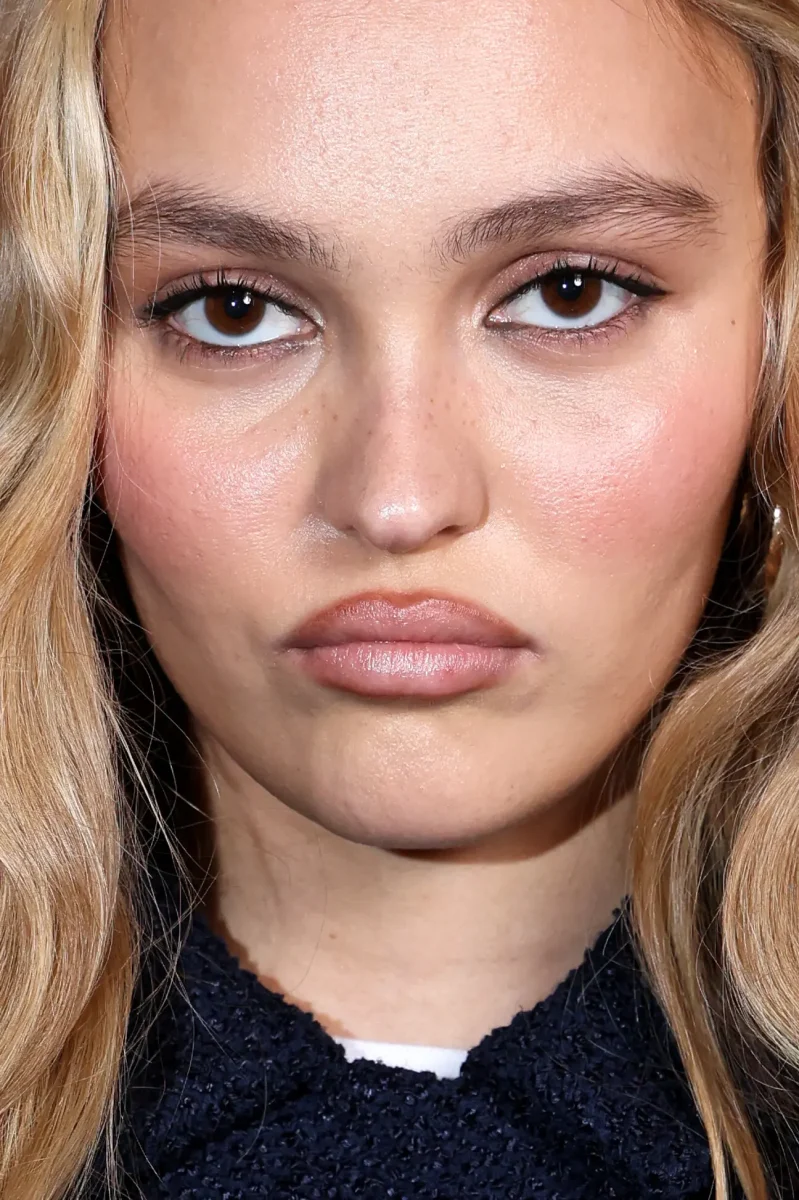
It’s the new look: the “Gen Z Pout” face. Worn by popular young female celebrities like Lily-Rose Depp and Ariana Greenblatt, this trending expression involves pursing one’s lips just enough to convey the “I don’t care, I’m fine with anything” look. The pout face now lives on non-celebrities like me, too. In fact, once I started paying attention to how I posed for pictures, I was embarrassed to find that my lips, as if they had a mind of their own, curled into a pout face without me realizing. Am I trying to come across as cool and unbothered? Honestly, maybe I am.
The 2026 Gen Z pout face was not born out of a vacuum; it has a predecessor, the “duck face,” which gained prominence through celebrities like Meghan Fox and Kim Kardashian in 2010. Similar to today’s pout face expression, the duck face was designed to help celebrities look as if they “happened to be photographed whilst contemplating [their] abject disaffection with the world around [them].” While both expressions foreground the lips as the center of attention, the pout face, according to several critics, sends a stronger, slightly more impolite message of “Fine. Take my picture if you so please,” while the duck face conveys a little more pleasant “Wait, let me look natural for the picture. Okay, now, go.” However, it’s worth considering why the pouty face has become so trendy among ordinary, non-influencer young adult women.
I feel that the Gen Z pout face trend partly arose from my generation’s obsession with lip fillers, lip injections, and basically everything lip-related (most beauty and skincare brands have “lip maximizers” or “lip plumpers”). The other, more probable reason is that we girls are expected to remain utterly “anti-cringe” by appearing nonchalant, detached, and, of course, cool-calm-collected-imalwayschill. I accidentally said “lowkey” in the middle of class the other day, and some of my classmates silently stared at me, clearly notifying me that I was being “cringe.” How come Gen Z boys get away with cringeworthy actions and phrases like “six-seven,” only drawing a couple of sarcastic chuckles from their peers, while if a girl does something of the same sort, the room grows quiet and awkward? Is it seriously necessary to intentionally find ways to prove our ‘non-cringe’ persona to friends and social media followers?
I get it: no one wants to be seen as cringe. Neither do I. But we can take things less seriously and avoid labeling people, specifically girls, and their actions as “cringe” or “outdated.” It’s okay to hit the Renegade in class. Say ‘lowkey’ as many times as you want. Wear skinny jeans. Play with slime. Chant ‘six-seven’ with your heart out, though you will likely gain some haters. Let’s all be a little cringe. Who cares? It’s better than trying to pose like a hangry toddler refusing to stick their bottom lip back in, merely to distance ourselves as far away from the culturally constructed (and ever-changing) concept of being “cringe.”
Works Cited
Holtermann, Callie. 2026. “What Is the ‘Gen Z Pout’?” The New York Times, March 26, 2026. https://www.nytimes.com/2026/03/26/style/gen-z-pout-millennials.html.
Justich, Kerry. 2026. “The ‘Gen Z Pout’ Is the New Selfie Face. The Subtle Expression Hints at How Young People See Beauty.” AOL.com. Yahoo. March 17, 2026. https://www.aol.com/articles/gen-z-pout-selfie-face-183822099.html.
Luce, Brittany, Neena Pathak, and Barton Girdwood. 2026. “It’s Been a Minute.” NPR. https://www.npr.org/2026/04/10/nx-s1-5779780/the-world-is-awful-is-it-healthier-to-stop-caring.
O’Neill, Shane. 2026. “How the Gen Z Pout Became Armor against Millennial Cringe.” The Washington Post. March 20, 2026. https://www.washingtonpost.com/style/trends/2026/03/20/gen-z-pout-photo-pose/.