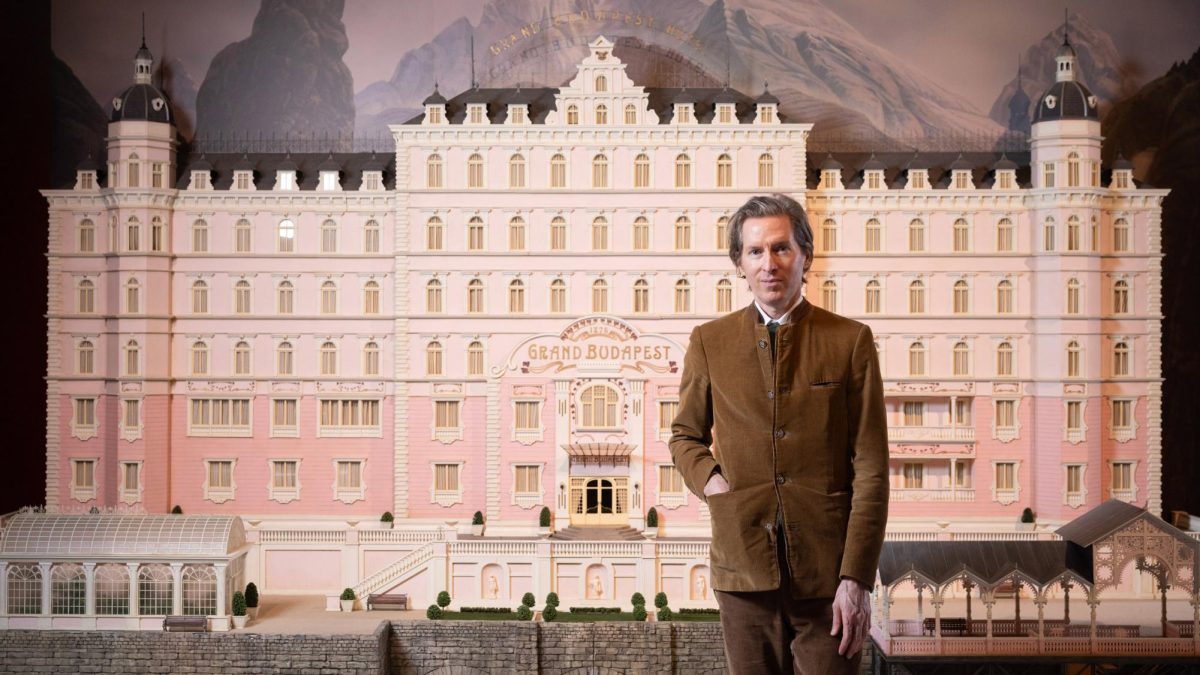
Wes Anderson, American director and screenwriter, is known for his distinctively quirky film style and aesthetic. Although Anderson initially faced criticism for his unique and eccentric taste, it is now what many find so comforting and enticing about his movies. Now, Anderson’s personal archives, comprising a wide range of souvenirs, notebooks, and more, are on full display at the Design Museum in London. The Museum has been granted full access to these archives, which has never happened before.
Curators Lucia Savir and Johanna Agerman Ross collaborated with Anderson to carefully curate an exhibit that reflects Anderson’s eccentric film style. The exhibit spans 14 sections, each containing around 700 objects, with one section for each of Anderson’s films. Designer Ab Rogers said that he intended to “create a universe of all his worlds to sit inside” and to represent the archives as “a continuous story.”
The films are sequenced in chronological order, which is reflected in the display through its components, such as the wall color and the layout of each room. For example, the earlier rooms have red walls to represent Anderson’s first feature film, Bottle Rocket, and the final room has a pink wall for Asteroid City.
The mementos featured in this exhibit are carefully selected as well. The first few rooms display objects from Anderson’s early career, including props from Bottle Rocket as well as sketches and storyboards from the film, offering an unprecedented view of the creation and development of Anderson’s films. Additionally, the exhibit displays souvenirs from later films, among them the Jaguar Shark from The Life Aquatic with Steve Zissou (2004) and the Francine Odyssey book from Moonrise Kingdom (2012).
Next, the display focuses on Anderson’s stop-motion projects, including the models of the clay characters from Fantastic Mr. Fox (2009) and Isle of Dogs (2018), as well as a scale model of the Grand Budapest Hotel from Grand Budapest Hotel (2014), one of Anderson’s most well-known films. The exhibit closes with objects from Anderson’s more recent films, including the Phoenician Scheme (2025), making it the perfect ending, as it is the final movie of Anderson’s career for now.
The exhibit may expand as Anderson continues to produce and write movies, but for now, the public will have access to these archives only until July 26, 2026. This exhibit not only represents Anderson’s career but also reflects his attention to detail and funky style through the design and display of the mementos. This exhibition offers a more comprehensive view into the behind-the-scenes work that went into these postmodern films.
Works Cited:
Britannica Editors. “Wes Anderson”. Encyclopedia Britannica, 6 Jan. 2026, https://www.britannica.com/biography/Wes-Anderson. Accessed 5 February 2026.
Eberhardt, Ellen. “Design Museum displays never-before-seen Wes Anderson film props.” Dezeen, 20 Nov. 2025, www.dezeen.com/2025/11/20/design-museum-wes-anderson-the-archives-exhibition/#:~:text=For%20the%20exhibition%2C%20curators%20Lucia,sections%2C%22%20said%20Agerman%20Ross. Accessed 5 Feb. 2026.
Ross, Johanna Agerman, et al. “10 Unmissable Highlights from Wes Anderson: The Archives.” The Design Museum, designmuseum.org/exhibitions/wes-anderson-the-archives/10-unmissable-highlights-from-wes-anderson-the-archives. Accessed 5 Feb. 2026.
“Wes Anderson: The Archives.” The Design Museum, designmuseum.org/exhibitions/wes-anderson-the-archives. Accessed 5 Feb. 2026.