The Guggenheim, one of New York City’s sought-after contemporary art museums known for its striking architecture and avant-garde exhibitions, recently opened Robert Rauschenberg: Life Can’t Be Stopped to commemorate the artist’s 100th birthday.
Rauschenberg is known for his Neo-Dadaist style, an artistic and literary style that emerged in Zurich, Switzerland, following the end of World War I. The movement was a reaction against the “nationalist and colonist interests” believed to have sparked the war, as well as the cultural conformity that accompanied it. However, the movement, or more accurately identified, the upheaval, mocked and challenged the conventions of art itself—leaning into collage, montage, and assemblage to create works that reflected the artists’ left-wing political views and disapproval of societal uniformity. Revived in the late 1950s, Neo-Dadaism drew on the playful spirit of Dadaism while emphasizing the era’s increasing commercialization and strengthening mass culture.
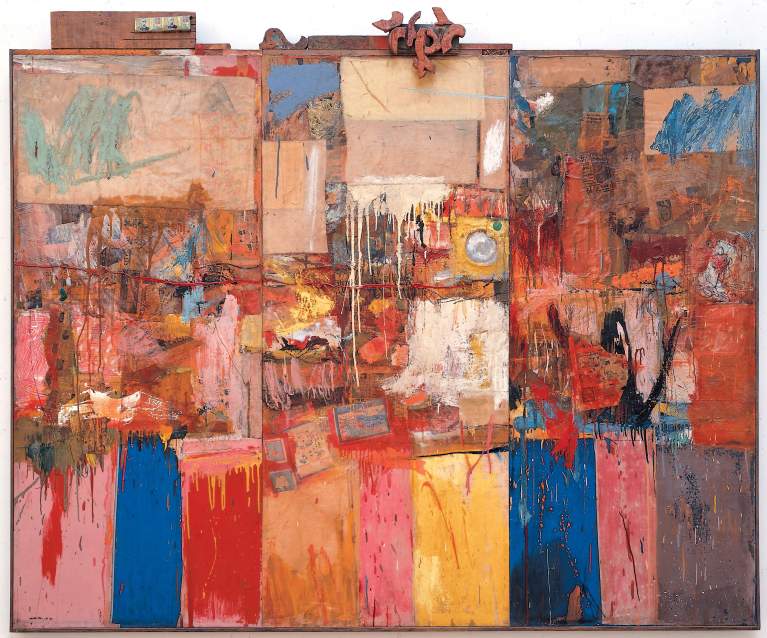
Rauschenberg’s art reflects the industrial landscape and “oily iridescence” of his native city, Port Arthur, Texas, with its scrappiness and inventiveness mirroring his frugal upbringing. His most famous collection of works is titled Combines. Fittingly so, the messy yet masterful arrangement of everyday objects amid layered acrylics and silkscreen inks represents Rauschenberg’s eccentricity and his penchant for risk-taking. Of the series, his most famous piece is titled Bed (1955): created not on a canvas, but rather born from his own quilt, sheet, and pillowcase. A testimony to the latent beauty of everyday objects, Rauschenberg animates the seemingly boring parts of our lives that we know all too well.
On October 10th, the Guggenheim opened the exhibition to the public, featuring a curation composed of pieces from both the Robert Rauschenberg Foundation and the Guggenheim’s collection. The heart of the collection is titled Barge (1962), a 32-foot-long silkscreen painting of collage-like composition incorporating a vast array of imagery. The Guggenheim’s Robert Rauschenberg: Life Can’t Be Stopped celebrates his daring creativity, his transformation of the mundane into the extraordinary, and his innumerable contributions to the evolution of the contemporary art movement.
Sources:
“Collection in Focus: Robert Rauschenberg: Life Can’t Be Stopped.” The Guggenheim Museums and Foundation, www.guggenheim.org/exhibition/collection-in-focus-robert-rauschenberg-life-cant-be-stopped. Accessed 4 Nov. 2025.
“Dadaism Definition, History, and Famous Dada Artists – 2025.” MasterClass, 29 Sept. 2022, www.masterclass.com/articles/dadaism-guide.
“How Robert Rauschenberg Created the First Artwork for Earth Day.” How Robert Rauschenberg Created the First Earth Day Artwork | Christie’s, 22 Apr. 2025, www.christies.com/en/stories/robert-rauschenberg-earth-day-artworks-acf88945e7d6491392f5250880b9d0e7.
Robert Rauschenberg. Bed. 1955 | Moma, www.moma.org/collection/works/78712. Accessed 4 Nov. 2025.
“Robert Rauschenberg.” Wikipedia, Wikimedia Foundation, 10 Oct. 2025, en.wikipedia.org/wiki/Robert_Rauschenberg.
Solomon, Deborah. “Happy 100th Mirthday, Robert Rauschenberg – The New York Times.” The New York Times, 10 Oct. 2025, www.nytimes.com/2025/10/10/arts/design/rauschenberg-centennial-guggenheim-mcny.html.