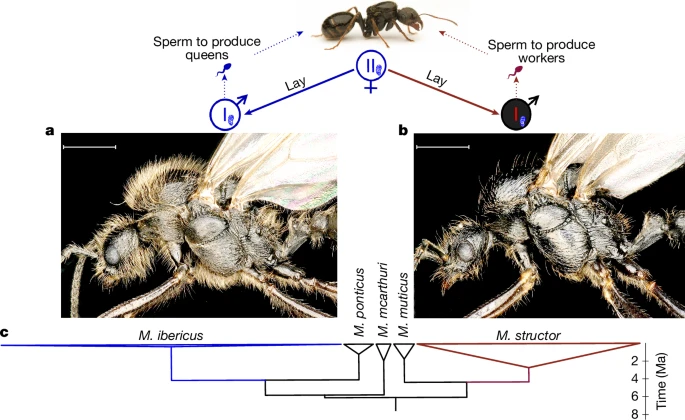
On September 3rd, 2025, an astonishing biological discovery titled “One mother for two species via obligate cross-species cloning in ants” was published in the journal Nature, which reports a discovery about an ant species called Messor ibericus. In M. ibericus colonies, the females give birth to two distinct types of offspring: male Messor ibericus and male Messor structor. The phenomenon reflected by this discovery is named “xenoparity,” which crosses species barriers and overthrows the previous assumption that each animal species may only give birth to individuals of the same species.
According to the article, it is inferred that while giving birth to M. structor, females of M. ibericus in fact clone males of M. structor to form the caste of workers. This is done by storing the sole source of genetic material from the male which are, in this case, sperms of M. structor males, in the body of the queens; on the other hand, the females only provide the mitochondrial genome (inheritance material in mitochondria) of the workers. Then, the queens may mate with M. structor males to produce hybrid males of M. ibericus. Thus, they are able to continue this reproductive pattern since the colonies contain M. structor males.
The scientists reached this explanation first by discovering that the males of M. ibericus are hybrids through the analysis of genome-wide data and finding out that workers of M. ibericus have an extraordinarily high heterozygosity. Then, by analyzing their mitochondrial genomes and nuclear DNA, the scientists identified the maternal and paternal ancestry of male M. ibericus. Furthermore, the scientists observed that in 132 sampled males in M. ibericus colonies, 56% of individuals correspond to M. structor, and the rest correspond to M. ibericus. Further confirmation suggests that queens of M. ibericus lay offspring belonging to these two species, since 9% of the eggs laid by the sampled queens contained only the nuclear genome of M. structor.
Nowadays, in the region where the discovery was made, the colonies of M. ibericus and M. structor are far apart. Thus, this unique way of reproduction amongst M. ibericus suggests that long ago, when the habitats of two species were overlapping in that region, the females of M. ibericus first started cloning males through sperms they stored from M. structor. Before this scenario, M. ibericus might exploit sperm directly from co-occurring M. structor colonies.
Additionally, scientists found out that the M. ibericus colonies maintain a unique clonal lineage of M. structor in contrast to the wild-type lineage found in M. structor colonies. The scientists also found a certain proportion of hybrid male M. ibericus that have the paternal genome of wild-type M. structor, only existing in the limited region where M. structor and M. ibericus both inhabit. This suggests that cloning M. structor helped M. ibericus to inhabit a wider region.
This new discovery surely redefines our comprehension of how living things reproduce and may result in a large alteration of the knowledge architecture of biology. On the other hand, there are still lots of mysteries about xenoparity. How did the queens of M. ibericus get rid of the nuclear genome in their own egg cell precisely and insert the nuclear genome from M. structor? Does this phenomenon occur in any other species? All these questions are followed by opportunities to develop human technology and to discover more about nature.
Works Cited
Juvé, Y., Lutrat, C., Ha, A. et al. One mother for two species via obligate cross-species cloning in ants. Nature 646, 372–377 (2025). https://doi.org/10.1038/s41586-025-09425-w