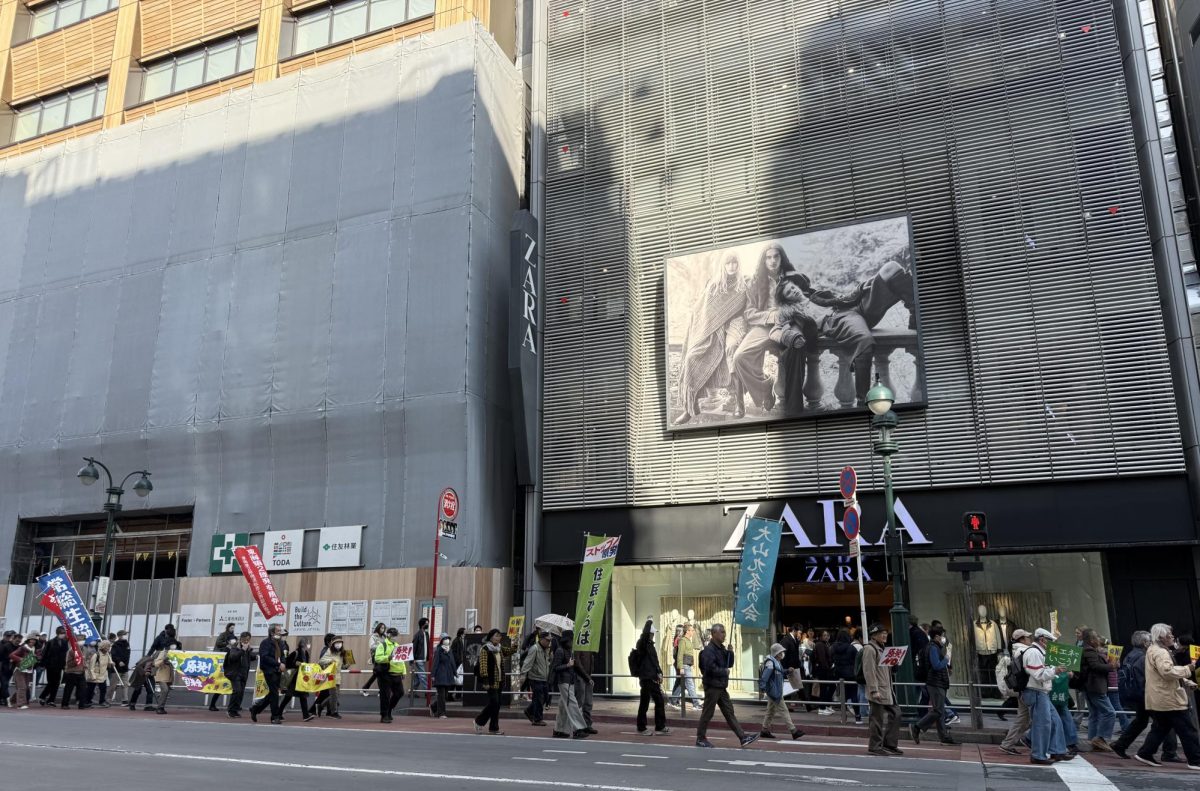
During my brief visit to Shibuya Scramble, one of Tokyo, Japan’s hottest shopping and tourist attractions, I felt a bit embarrassed. Walking along the crowded streets were not merely English-speaking tourists like myself, but enraged locals protesting against something that I had no idea of. They were holding signs that read “No Nukes!” and “Anti-Iran Strikes!” yet I was confused as to why the Japanese had such a strong opinion against U.S. military actions in Iran. What was their political history? During the rest of my trip, I slurped down some articles and tried to make sense of the rallies I encountered in what I had mistakenly thought was a receipt-filled, politics-free tourist attraction.
Amongst many countries dependent on Iran and the Strait of Hormuz for oil, Japan is arguably one of the largest importers, with 90% of its oil supply originating from Iran. Consequently, the Japanese government scrutinizes Iran’s domestic and international stability, as Iran’s fickle geopolitical status has a drastic impact on Japan’s everyday economy and civic life. Hence, top politicians, such as Japanese Prime Minister Saine Takaichi, find it necessary to prioritize promoting Iran’s stability, albeit only verbally. Another factor Takaichi must consider is Japan’s already strained relationship with the United States, which means she cannot explicitly condemn U.S.-Israeli strikes without risking souring an important alliance. With these broader national and geopolitical interests in mind, the Japanese government has maintained neutrality in discussions about strikes on Iran and alternatively emphasized ongoing diplomatic conversations between the U.S., Israel, and Iran, along with calls for descalating Iran’s nuclear development to protect Iran’s internal security and international reputation.
While Japanese politicians, especially those belonging to the liberal democratic party (LDP), may take a more neutral stance to safeguard Japan’s economic and sociopolitical status, there appears to be a plethora of civilian factions, each with relatively opinionated views on the issue of U.S.-Israeli strikes and, more importantly, the killing of Iran’s former leader, Ayatollah Ali Khomeini. One of these groups is the Yokosuka Non-Nuclear Declaration Movement, who protest against pre-emptive strikes by the United States on Iran through the use of Japanese Ships in Yokosuka. Another is the YWCA, the Young Women’s Christian Association of Japan, a pacifist activist group that opposes militarism and aggression as means of solving international disputes, especially because innocent women, children, and other minorities usually suffer the most. Groups like the YWCA criticize legal arguments put forth by the United States that attempt to justify aggression, such as the most recent one stating the U.S.’s right to employ Japanese bases for military purposes as long as it is for the benefit of Japan’s national security and international peace. Pacifist groups assert that if Japan permits such deeds, it would make Japan a complicit actor in what evidently is becoming an escalating global military conflict.
The third and final (aside from other miscellaneous groups that I unfortunately cannot dive into in detail due to space and your precious time) group of people participating in protests is Iranians, their families, and close friends, many of whom despised the previous regime’s anti-democratic tactics and welcome the chance for a new leader to stabilize their country. Many Japanese-Iranians actively expressed gratitude for President Trump and the United States for orchestrating attacks on Ayatollah Ali Khomeini and his family, as they claim that violence was the sole way to terminate Iran’s monarchy and oppressive atmosphere. Even those who hesitate to approve of Trump’s actions, being aware of how many innocent victims were killed due to the strikes, concede that Khomeini’s death outweighed the disastrous consequences. “This is the only way everyone can become free,” one vocational-school Iranian student said. And this opinion seems to be the predominant one.
You might be wondering, after reading all of this, what led to Iranian immigration to Japan in the first place. After the Iran-Iraq war of 1980, Japan had agreed to accept young Iranian men seeking employment on short-term visas. Due to the surge in anti-Western Islamic sentiments in Iran at this time, most Western countries had closed their doors, making rapidly modernizing countries like Japan a desirable destination to start fresh. When the number of illegal immigrants increased in the 1990s, Japan briefly restricted Iranian arrivals for several years. However, this policy immediately sparked debates. Both Japanese citizens and Iranian residents argued that deporting Iranian children with no legal status would violate basic human rights. As a result, immigration restrictions loosened throughout the late 1990s and early 2000s. Today, approximately 5,000 Iranians live in Japan, and most–along with their Japanese allies–of them are not afraid to express their opinions s on current Iranian politics and international affairs. As they should!
I’m proud to say that I can now stroll through Shibuya and at least gauge what kind of protests are happening and why. This 3-day trip to Japan reminded me why I love traveling: I get to arrive knowing barely anything, and leaving with a little bit more knowledge and curiosity:) I hope all of your spring vacations take you somewhere new–whether to ethnically diverse cities, quiet mountain trails, or the calm countryside. May any place expand your worldview both physically and intellectually!
Works Cited
Arab News Japan. “Activists in Tokyo Rally against US and Israeli Attacks on Iran.” Arab News Japan, 1 Mar. 2026, https://www.arabnews.jp/en/japan/article_165489.
Arab News Japan. “Japan Issues Warning as Tensions Rise in Iran.” Arab News Japan, 2026, https://www.arabnews.jp/en/japan/article_165097.
Arab News Japan. “Iranians and Supporters Demonstrate in Japan over Iran Conflict.” Arab News Japan, 2026, https://www.arabnews.jp/en/japan/article_165563.
The Japan News. “Japan Government Responds to Iran Crisis.” The Japan News, 7 Mar. 2026, https://japannews.yomiuri.co.jp/politics/politics-government/20260307-315074/.
The Asahi Shimbun. “Japan-Iran Relations and Domestic Reactions.” The Asahi Shimbun Asia & Japan Watch, https://www.asahi.com/ajw/articles/16390455.
“‘Iran Airstrikes’ Win Praise from Iranian Protesters in Japan.” Japan Forward, https://japan-forward.com/iran-airstrikes-win-praise-from-iranian-protesters-in-japan/.
The Japan Times. “Iranian Residents in Japan Worried amid Escalating Conflict.” The Japan Times, 3 Mar. 2026, https://www.japantimes.co.jp/news/2026/03/03/japan/society/iranian-residents-japan-worried/.
Nomani, Farhad, and Others. “Japan IV: Iranians in Japan.” Encyclopaedia Iranica, https://www.iranicaonline.org/articles/japan-iv-iranians-in-japan-1/.
United Press International. “Iranians Gather in Tokyo Welcoming US-Israeli Strikes.” UPI, 2 Mar. 2026, https://www.upi.com/Top_News/World-News/2026/03/02/iraninas-gathered-tokyo-welcoming-us-israeli-strikes/6611772512179/.